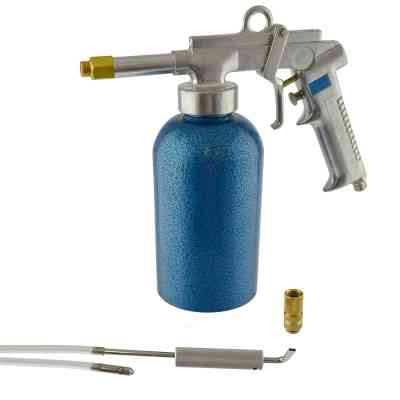
A step-up in quality if you will be using the equipment frequently is the professional-standard Lemmer HD460 rust proofing kit.
You’ll buy the wax either pre-filled in Schutz cans that screw onto your Schutz-compatible spray gun, or in containers that need to be decanted into an empty Schutz can or your gun’s bottle.
Safety first
Check the manufacturer’s recommendations for safety equipment. However, even where personal protection equipment is not essential (such as with Rustbuster’s natural lanolin-based Corrolan range), we suggest that you wear goggles, mask, gloves and overalls or a spray suit.
Masking off
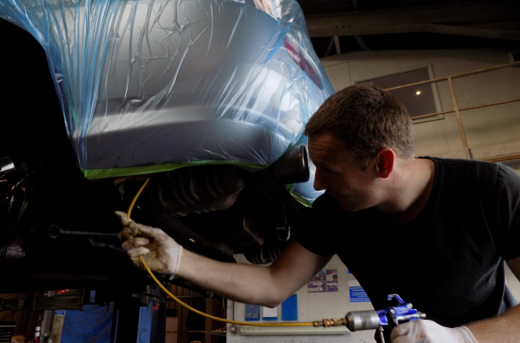
The process starts with protecting the areas you DON’T wish to get the wax treatment. Use a combination of masking tape, plastic or strong paper to cover brake hubs, discs and pads. Ideally, you should also mask off the exhaust system and heat shields so that you aren’t introducing extreme heat to any wax.
We would also recommend masking off at least the first few inches of body paintwork above the line you’ll be waxing to. Masking tape and paper is the classic way to protect against overspray. However, you can use masking wrap instead of paper. This integrates masking tape with a wrap that sticks to the vehicle via static energy to provide excellent protection.
Applying the wax
However you apply the wax, it’s a good idea to immerse the container of wax in warm water to soften it prior to application. (Always check individual product specifications/instructions for the suitable temperature.) This will reduce the viscosity of the wax, so that you can apply it without having to add a thinner. Alternatively, use the wax manufacturer’s recommended thinner to achieve the required viscosity.
The application process can be broken down into three main categories:
- Penetrating
To begin a complete wax protection treatment, ideally you should start by coating the suspension components, seams and joints between body panels, and other areas with complex surfaces or small voids. The idea is to get wax into all these tiny pockets where water will inevitably follow. Spray the penetrating wax across these areas and then work it in with a dry paintbrush. After 15 minutes, wipe away any excess wax that is laying wet on the surface with a lint free cloth.
Use a specialist penetrating wax with a thinner consistency than usual. This will enable it to penetrate the smallest crevices. A wax of this type can also be used as a base coat in cavities.
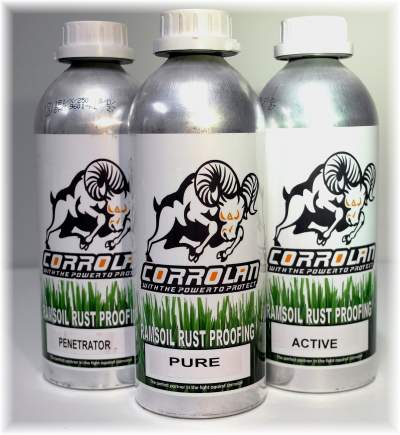
Suitable products: Corrolan Penetrator is the thinnest of the three products in the Corrolan range and is ideal for this stage of the process. When using the Corrolan system it also works very well as a kind of undercoat across all the underbody prior to application of Corrolan Pure.