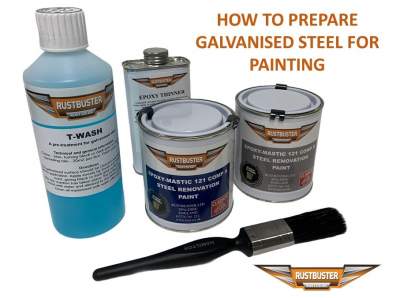
If you are ever faced with the task of painting galvanised steel, some preparation may be needed to help ensure an effective job. In this article we look at why this is so, and the type of preparation required. But first, a little history…
In 1836, Stanislas Sorel in France took out the first of numerous patents for a ‘galvanic’ process of coating steel with molten zinc. The first UK use of galvanised corrugated iron is believed to have been for the Navy in 1844. Today galvanised metal is all around us, used in construction, transport, agriculture and everywhere that good corrosion protection is essential.
Coating steel with molten zinc prevents premature rust and corrosion because zinc corrodes very slowly, and therefore protects the steel’s surface. Due to the zinc being of lower nobility than steel – see our blog ‘Why do we use Zinc in our primers?’ – the zinc becomes sacrificial to the steel. (Zinc becomes the anode and steel becomes the cathode, creating cathodic protection.)
Does galvanised steel rust?
The answer is yes and no. Over many years, the deadly orange or brown rot will creep in, but very slowly and not as clearly visible as when non-galvanised steel rusts. Of course, there are a lot of factors that require answering when trying to determine how long the galvanising will last. These include the environment, whether there is contact with other metals, and how thick the zinc was applied. Clearly galvanising a metal surface with 125μm (microns) of zinc is better than 25μm, but also 5x the cost.
The graph below shows the relationship between zinc thickness and the corrosion rate: