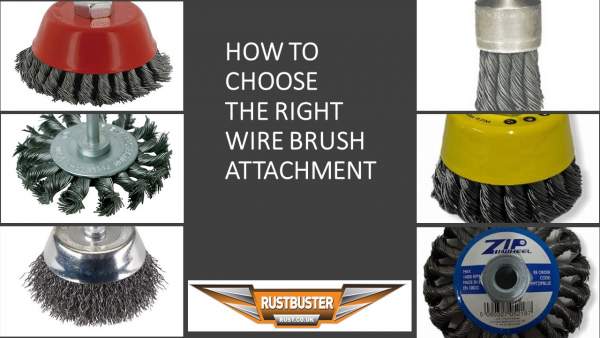
Don’t just grab the nearest available drill or angle grinder brush attachment. Putting a little thought into choosing the right attachment for the job can lead to better results. In this article we discuss your options, and share some tips for getting extra performance from your brush attachments.
The great advantage of wire brushes over solid abrasive wheels is that they are very unlikely to remove metal or significantly change the profile of the surface. Wire brushes are also non-loading, so they won’t become clogged with material. These advantages often mean that they are ideal for rust removal, as well as deburring, cleaning up fresh welds and general surface preparation before painting.
How do wire brush attachments work?
The word ‘brush’ is not in fact a very accurate name. Rather than ‘brushing’ the surface, wire brush attachments are designed to work like sandblasting. Instead of bombarding the metal with sand, the high-speed rotary action of the drill or grinder causes the tips of the individual brush filaments to hit the surface. It’s like hundreds of tiny hammers blasting the surface.
To use a brush attachment effectively, avoid pressing too hard. This will help to ensure the necessary hammer action at the tips of the filaments, rather than ‘swiping’ the surface with the length of the filaments. Also, applying too much pressure will cause the wires to heat up and shorten brush life.
Crimped or twist knot brushes?
The first factor to consider when choosing your attachment is whether to go for crimped or knot wire brushes:
Crimped wire brushes can be thought of as good light to medium duty tools. The crimping of each wire in the brush is done so that the individual wires act as support for each other.
The main point to bear in mind about a crimped brush is that the wires are separate from each other. The brush remains reasonably flexible during use. Use a crimped wire brush on irregular surfaces where you need good brush flexibility, or if you are concerned that a knot wire brush could damage the metal you are working on.
Twist knot wire brushes are for more heavy-duty work. The wires are twisted together like rope in order to deliver a more aggressive action against the metal surface. This extra firmness and less flexibility make them suitable for removing heavy rust or other contaminates/coatings on the surface.